
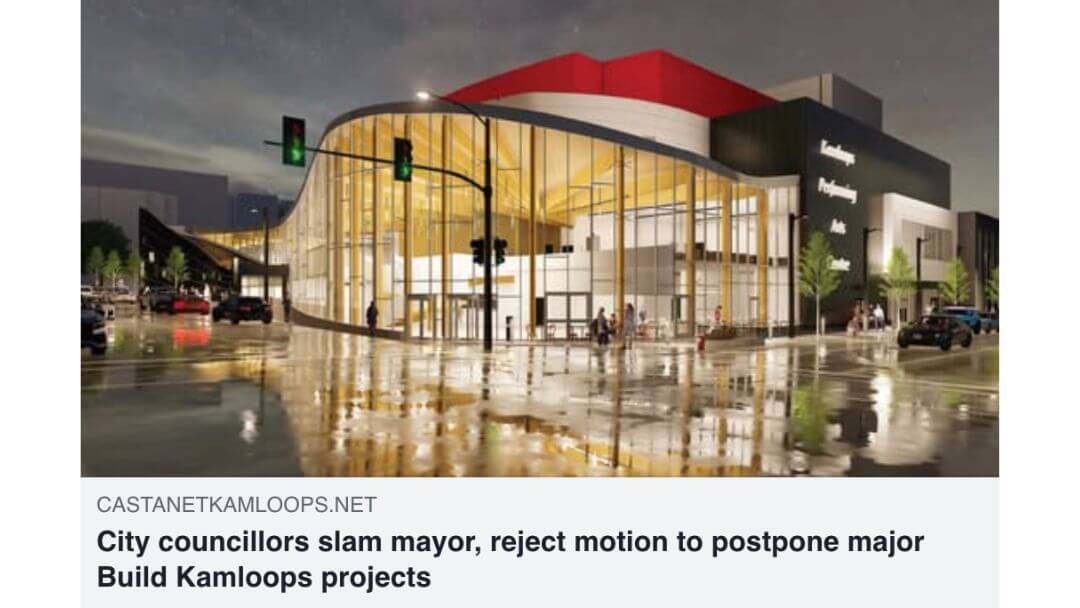
𝐂𝐨𝐮𝐥𝐝 𝐂𝐚𝐬𝐭𝐚𝐧𝐞𝐭 𝐩𝐥𝐞𝐚𝐬𝐞 𝐫𝐞𝐩𝐨𝐫𝐭 𝐛𝐨𝐭𝐡 𝐬𝐢𝐝𝐞𝐬 𝐨𝐟 𝐭𝐡𝐞 𝐬𝐭𝐨𝐫𝐲 𝐰𝐡𝐞𝐧 𝐢𝐭 𝐜𝐨𝐦𝐞𝐬 𝐭𝐨 𝐂𝐢𝐭𝐲 𝐇𝐚𝐥𝐥?
In a March 26 Castanet article (see screenshots), residents are expected to accept vague claims from council members without any documentation or basic fact-checking.
That’s not transparency—it’s PR spin and obfuscation from City Hall, echoed by Castanet.
It’s concerning that Castanet appears to prioritize continued access to City Hall and Council members over balanced reporting—and it’s unfair to readers.
There is a documented history of tension between the mayor and a senior member of this newsroom, including published opinion pieces—which makes objectivity all the more important.
Castanet continues to amplify City Hall’s messaging while excluding opposing viewpoints and scrutiny.
That’s not journalism—it’s one-sided coverage—and it needs to change.
A sidenote: comments were turned off on the article about Castanet receiving an award from the City… we'll leave that there.
Here are KCU’s questions within the article—that residents should be asking:
Kamloops councillors blasted Mayor Reid Hamer-Jackson for spreading misinformation and creating instability with a motion to delay two major capital projects.
→ What specific misinformation are they referring to? Where is it identified-and proven false?
Hamer-Jackson was looking to “immediately postpone” advancement of the $211-million Kamloops Centre for the Arts and the $140-million arena multiplex for one year, or until the next council decides what to do.
Council rejected the motion with an 8-1 vote on Tuesday. The mayor was the only one in favour.
→ There was no meaningful explanation of why a financial review was considered unreasonable.
The majority of council argued delaying the projects would only drive up costs and jeopardize grants and sponsorships tied to their progress.
→ So can getting the scope, assumptions, or budget wrong upfront.
→ Where is the analysis of the cost of proceeding without full clarity?
Construction contracts have been awarded for both Build Kamloops banner projects, and in the case of the arts centre, earthworks have already begun.
→An independent cost review can be undertaken without a pause.
Coun. Kelly Hall, chair of council’s Build Kamloops committee, said the proposed delay would greatly increase project costs when factoring in inflation and potential lawsuits.
→ The city is using an Integrated Project Delivery (IPD) process for these projects—where a selected contractor team works collaboratively to develop scope, schedule, and pricing.
→ Under IPD, what binding contracts currently exist that would trigger lawsuits if paused—are these identified legal risks, or speculative ones?
Hall said the projects already “sat on the fence” for months while an unsuccessful court challenge was launched against the method used by the city to approve borrowing for the facilities.
According to Hall, that delay added about $7 million to the cost of the arts centre, and $5 million for the arena multiplex.
→ Term “unsuccessful” was not used by Hall—added by reporter
→ Where is the detailed calculation for those figures—how much was inflation, how much was market escalation, and how much was scope-related?
“This notice of motion would cost the city taxpayers $38.85 million to delay it, after three and a half years of solid work with engagement groups, people of the community that care for the community,” Hall said.
→ This is a major claim. Where is the line-by-line breakdown-what assumptions were used?
→ What portion is verified, and what portion is projected or speculative?
→ Residents are reading a talking point—without independent verification of the numbers behind it.
Coun. Mike O’Reilly said people should have been aware of the financial risks of Hamer-Jackson’s proposal. “As the mayor and CEO of the corporation, you create instability by providing misinformation, spreading it, and only sharing 10 per cent of the information,” O’Reilly said.
He said while the court challenge was part of the democratic process, the delay and uncertainty resulted in missed sponsorship opportunities for the capital projects.
→ What specific sponsorships were lost, and were any formally secured?
“We have missed out in millions and millions of dollars in sponsorship from national and multi-national corporations that we had been working with that want to sponsor facilities,” O’Reilly said.
→ Which corporations, what amounts, and is there documentation to support this claim?
“When the AAP challenge got put forward, they walked. That’s where we're at.”
→ Who specifically “walked,” and what evidence confirms they withdrew due to the AAP challenge? This isn’t verifiable—it’s a claim.”
In the past, Hamer-Jackson had supported a performing arts centre and the city’s Build Kamloops program. He said he was now concerned that federal and provincial grant funding for the project won’t be available due to budget constraints and tough economic times.
Several councillors noted grant funding—from government or corporate sponsors—requires project progress and confidence, not delays or pauses.
→ Some grants are available in early planning or pre-construction stages.
→ Which specific grants are contingent on continuous advancement, and what are their actual deadlines and conditions?
→ Has the City now filled a full-time grant writer position to actively secure available funding?
“The more that we flip and flop on it, the more likely we are to lose them, because money in their hands can go somewhere else,” said Coun. Stephen Karpuk.
Councillors said grant programs are still available with Coun. Katie Neustaeter saying some Lower Mainland communities were, as recently as Friday, celebrating receiving funding for certain projects. They said the next few years will be an opportune time to ask for grants as the cultural and recreation projects progress.
→ Those projects were not large standalone performing arts centre projects.
→ If funding opportunities are still ahead, that supports taking time to get the scope and finances right.
Coun. Nancy Bepple said the mayor’s motion neglected to mention the City of Kamloops already receives ongoing grants from provincial and federal governments, some of which can be used for these capital projects.
→ Which grants are referred to, and how much of that funding is actually allocated to these projects?
→ If grants are being reallocated, what projects or organizations are losing that funding as a result?
In his motion, Hamer-Jackson said the projects “represent significant long-term financial commitments that may affect municipal finances and taxpayers for decades.”
Bepple countered this assertion, saying debt per capita has been in decline for years, and the tax impact from the Build Kamloops borrowing project is comparatively lower than past recreation projects.
→ Declining debt per capita doesn’t address the impact of taking on new, large-scale debt now.
She said in 1988, the average lot saw a $186 increase in taxes over five years to pay for Sandman Centre—which she calculated to be $440 in today’s dollars.
In 2003, taxpayers saw a $378 increase over three years in today’s dollars to pay for the Tournament Capital Centre and extensive renovations at the McArthur Island Sport and Event Centre.
→ A 1988 comparison does not reflect today’s construction costs, project scale, or long-term financial risks.
→ That increase didn’t disappear after five years. Council presents impacts over five years only—because that’s all they are legally required to show. In reality, this borrowing is repaid over decades, and those increases remain built into the base tax.
Bepple said borrowing for the performing arts centre, arena multiplex and additional design work for future Build Kamloops projects will result in a $133 tax increase over five years for the average lot.
“That’s a bargain,” Bepple said, adding this is because Kamloops’ population has increased and can share the costs among more ratepayers.
“The argument that this is such a huge expense for the community does not ring true in terms of those past projects.”
→What is the total expected taxpayer cost over the full repayment period for these projects—not just a five-year snapshot?
She also called the mayor out for not attending closed council meetings in more than 567 days.
“If he is actually committed to helping guide the decision making for Build Kamloops, I would suggest that he show up for the other half of his job,” Bepple said—a statement which resulted in calls of “hear, hear” from other councillors.
“You’re all out of order,” Hamer-Jackson said.
Councillors said although the mayor’s motion resulted in about 275 letters of support coming to council—many of them a copy-and-paste template—there is also a significant amount of community support for the recreation and capital projects, many of whom also sent emails to council.
→ In the meeting, the Mayor said he received hundreds of emails in support of the motion over the days leading up to the council meeting.” 275 on the first day alone.”
“I actually listen to the citizens,” Hamer-Jackson said, adding community members—including himself—are having a hard time paying taxes.
“Which taxpayers are you speaking up for?” Coun. Dale Bass asked, adding council members must represent the city as a whole.
Coun. Bill Sarai said the performing arts centre will bring benefits to downtown Kamloops and the surrounding business. He pointed to the recent opening of a new skating loop in Riverside Park as a glimpse at the buzz that could be.
“This is exactly what downtown needs—that extra shot of excitement to give the business community, business owners that are just struggling because of the economics,” he said.
Read the Castanet article here: City councillors slam mayor, reject motion to postpone major Build Kamloops projects







0 Comments