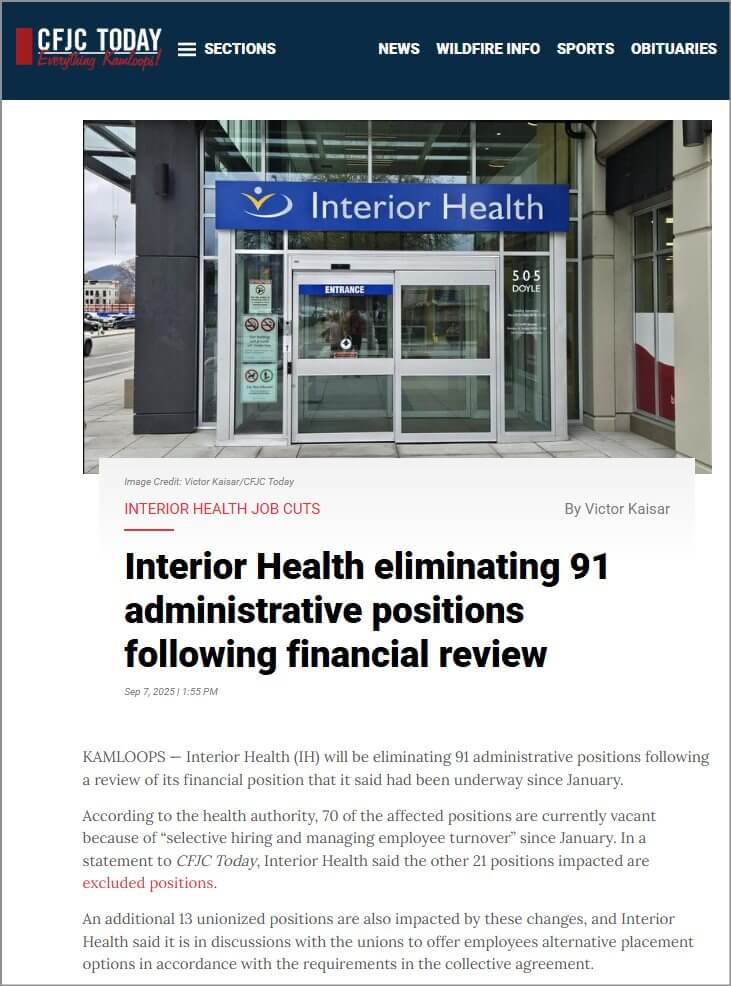
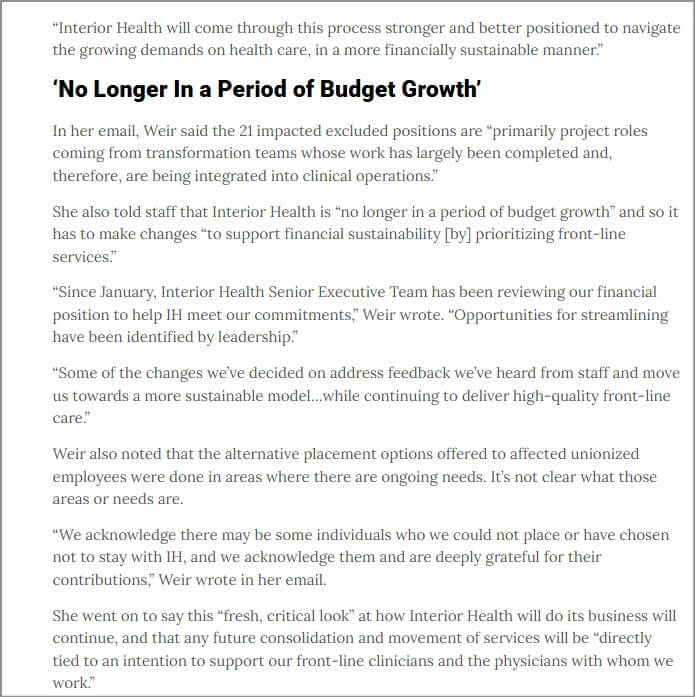
Interior Health is cutting 91 administrative positions after a financial review—sending the message that public institutions must tighten up, prioritize front-line services, and trim bureaucracy.
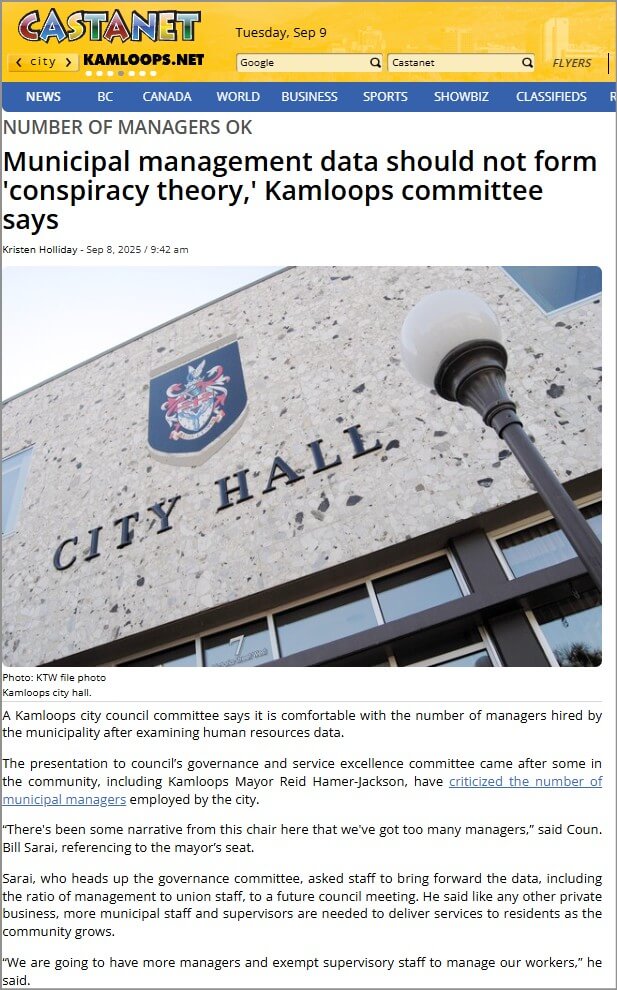
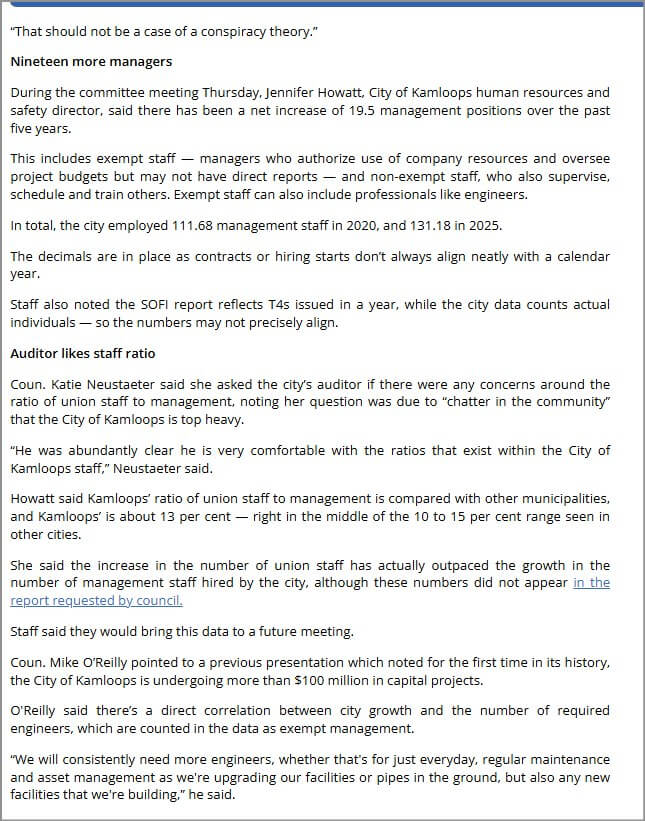
By contrast, since October 2020, the City of Kamloops has quietly added 19.5 permanent management positions at an average salary of over $100,000 per year.
Right on cue, city council members rushed to defend their management growth—before anyone asked.
-Coun. Bill Sarai dismissed a previous concern as a “conspiracy theory,” and insisted that more managers are simply part of a growing city.
-Coun. Katie Neustaeter cited the city auditor’s comfort with staff ratios.
–Coun. Mike O’Reilly pointed to $100 million in capital projects, claiming the city will “consistently need more engineers”.
The talking points are an attempt to obscure the truth: management has far outpaced service delivery. In 2024 alone, management payroll jumped a whopping 13%—from $13.5 million to $15.6 million.
That’s a $2.1 million spike in a single year—nearly 5x the rate of inflation and 7x the rate of Kamloops’ population growth.
While the cost of living continues to climb for Kamloops residents, and 1 in 4 Canadians are now using a food bank—City Hall is increasing exempt payroll at a record pace—not due to union contracts or retroactive pay, but by deliberate choices made by council and senior administration.
The excuse council falls back on is always the same defensive line: “We’re growing.”
Growth should sharpen efficiency—not excuse a top-heavy City Hall.
More residents should mean smarter systems, better service, and leaner operations—not ballooning overhead and growing employee organizational charts. As population climbs, per-capita costs should stabilize or decline.
Capital projects are temporary. Project managers, engineers, and coordinator roles should also be temporary or contract-based. Future hires should be tied to clear performance metrics and published deliverables.
Kamloops, however, is folding them into permanent management—using short-term projects to justify long-term bureaucracy, dressed up as development needs.
Instead of interrogating City Hall on behalf of taxpayers and residents, this Council’s first instinct was to defend—rushing to justify growth with vague comparisons and claims of “comfort,” while other institutions tighten their belts and rethink staffing models.
Kamloops residents are paying more than ever. Council should be cutting the bloat—not defending it.
When will City Hall decide to value efficiency over spin—and residents over bureaucratic self-interest?








0 Comments